MCP
Anthropic introduced the Model Context Protocol (MCP) in late 2024 to standardize how AI applications communicate with external tools and data sources.
The problem it solves
An AI assistant becomes even more useful when it can act on real information and real systems. This is what MCP was made for: to provide a standard way to access external APIs, databases, files, and other systems.
How MCP works
MCP is an open protocol that defines how an AI application (called a host in the MCP specification) communicates with one or more MCP servers. It works over stdio for local processes and Streamable HTTP for remote servers. Older implementations may also use HTTP+SSE.
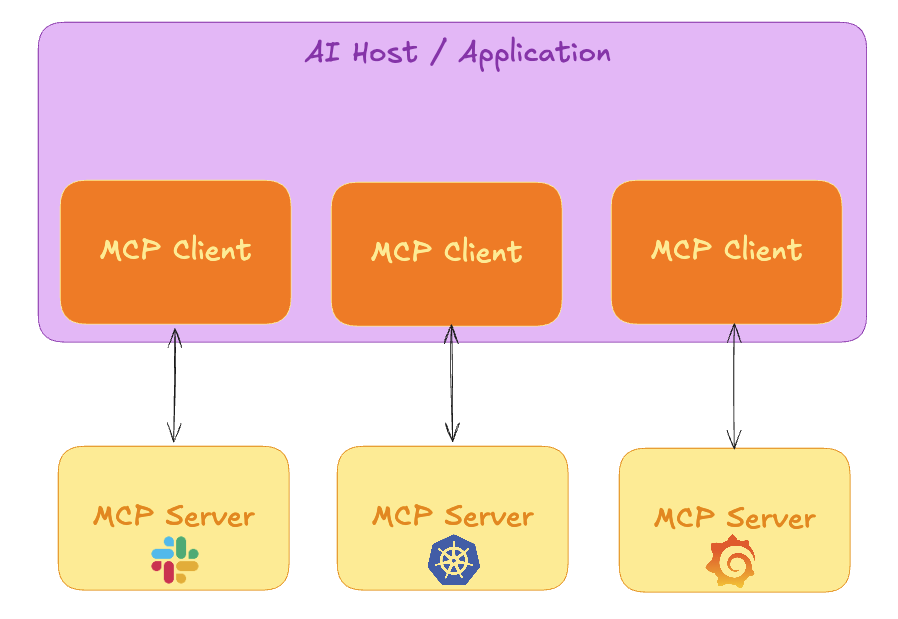
Each MCP server exposes its services in a standard way. The host maintains one MCP client per server and discovers the tools, resources, and prompts exposed by each server.
The protocol defines the communication between the host and the server, not the implementation of either side.
What an MCP server exposes
An MCP server can offer three types of capabilities:
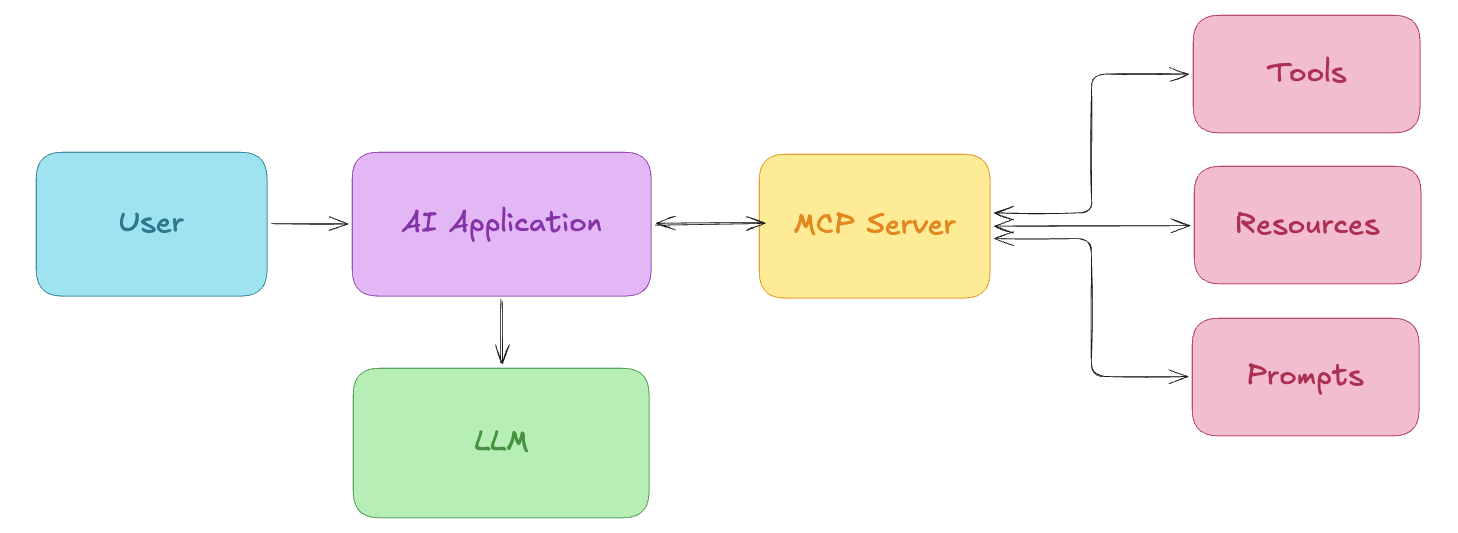
| Primitive | What it is | Example |
|---|---|---|
| Tools | Functions the AI application can invoke on the model’s behalf | kubectl_get, run_query, read_file |
| Resources | Data the model can read | A file, a database row, a config map |
| Prompts | Pre-built prompt templates | “Summarise this deployment’s events” |
Tools are the most common. When the model decides a tool is needed, the host calls the MCP server, receives the result, and adds it to the model’s context before continuing the conversation.
What MCP changes
Without access to an MCP server, an AI assistant answers using only the information available in the conversation and the model’s training data.
User: How many pods are running in my cluster?
Claude: I don’t have access to your cluster. You can check with
kubectl get pods -A.
With an MCP server for kubectl, Claude calls the tool and answers directly:
User: How many pods are running in my cluster?
Claude: There are 23 pods running across 4 namespaces. 2 pods in
monitoringare inPendingstate
The model decides when to use the tool. The user just asks a question.
Transports
| Transport | When to use |
|---|---|
| stdio | Local servers launched by the host |
| streamable HTTP | Remote servers |
Most local setups use stdio. Remote MCP servers are typically exposed over Streamable HTTP.
Key properties
Sessions: clients and servers establish a session before exchanging requests. Today, many implementations keep conversational state across requests, although the protocol is evolving toward stateless interactions (see SEP-2575).
Server-side logic: Credentials remain on the server, so the model never receives secrets or implementation details.
Composable: a host can connect to many servers at once; tools from all of them are available in the same conversation
Key takeaways
MCP is an open protocol that lets AI applications connect language models to external tools, data sources, and reusable prompts. It does not replace tool calling. Instead, it standardizes how applications discover and invoke external tools once the model has decided to use them.
MCP is widely used by coding assistants and AI agents because it gives them a consistent way to interact with files, databases, Kubernetes clusters, GitHub repositories, and many other external systems.
The MCP specification documents the full protocol if you want to build your own server.